
AAIF Group – Integrated Sports Surface Partner in the UAE
AAIF Group is a leading sports facilities provider in the UAE and GCC, uniting four specialist companies under one umbrella:
- Al Amal Al Sarea – Dubai: Sports flooring systems, court and field construction, playground solutions, and maintenance & after-sales.
- Al Mustaqbal Al Sarea – Ajman: Sports gear and accessories, R&D, global supply & distribution, and athlete partnerships.
- Infinity Middle East Industries – Umm Al Quwain: Stadium construction, engineering and technical services, court upgrades and renovations.
- Forsan Al Amal Al Sarea – Abu Dhabi: Sports equipment manufacturing, custom playground design, facility upgrades and stadium maintenance.
Thanks to this structure, AAIF Group can deliver both padel and football surfaces as part of turnkey sports facilities – from concept and design, through construction, to long-term maintenance support.
1. Two Different Sports, Two Different Surface Behaviours
Before comparing products, it is important to understand how each sport actually loads the surface:
- Padel: Compact courts, explosive short movements, frequent changes of direction, and ball rebounds from glass and mesh walls. Players need grip without being “stuck”, and consistent bounce in a small footprint.
- Football: Large fields, long sprints, sliding tackles, strong rotational forces from studded boots and long ball travel distances. The surface must manage higher impact forces over a much larger area.
Because of this, the ideal system for a padel court will never be identical to the ideal system for a football field. The engineering logic, layer build-up and performance criteria are different, even if both solutions use synthetic grass technology.
2. High-Performance Padel Court Surfaces by AAIF Group
In AAIF Group’s sports flooring portfolio, a padel court is treated as a fully engineered environment, not just a painted slab with some carpet on top. Each court combines:
- An engineered concrete or asphalt base with defined slopes and water channels.
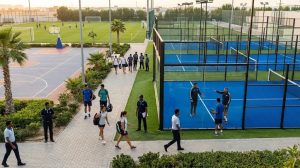 Optional elastic layers or shock pads to improve comfort and reduce impact loads on joints.
- Padel-specific synthetic grass designed to work with calibrated sand infill.
- A steel and mesh structure with certified tempered glass walls.
- Lighting designed to minimise glare on lobs and overhead shots.
The aim is to deliver a surface that supports fast rallies, predictable ball behaviour and comfortable footwork for many hours per day, especially in commercial clubs where courts are booked back-to-back.
2.1 What “Best Padel Turf” Means in UAE Conditions
In the context of the Emirates, the best padel surface is the one that can handle:
- Intense UV exposure without rapid fading or fibre damage.
- High temperatures and thermal cycles between day and night.
- Dust and sand carried by the wind, which can accumulate in the infill.
- Occasional heavy rain, requiring effective drainage and fast drying.
For AAIF Group, choosing the best padel turf is therefore not just about the yarn type; it is about how the surface, base and drainage are built together so that performance remains stable and safe over many seasons of intensive use.
3. Football Pitch Synthetic Systems in the AAIF Portfolio
The AAIF Company Profile 2025 describes several football surface systems with clear specifications. These systems are designed for community pitches, training grounds and full-size stadium fields, and are based on different origins and constructions.
3.1 UK Turf – Tiger Turf
Tiger Turf, manufactured in the UK, is a premium polyethylene artificial grass with a pile height of 50 mm. It uses fibres with a Dtex of 8,800 and a density of 10,500 stitches per m², delivering both durability and a natural look. The total height is 52 mm and the weight is over 1,000 g/m², making it suitable for football pitches and multipurpose sports fields that demand strong, reliable performance.
3.2 Vietnam Turf – High-Dtex Monofilament System
Vietnam Turf is engineered for long-term use, with a thick monofilament structure rated at 14,000 Dtex (±10%). It has a 60 mm pile height and a high stitch density that together provide excellent durability and softness. The system uses a double-layer primary backing and a PU secondary backing, creating a stable, robust foundation for heavy-use football projects.
3.3 Poland Turf – Two-Stem Monofilament System
Poland Turf is a synthetic grass system composed of polyethylene fibres in a two-stem monofilament structure. According to the profile, it features:
- Dtex: 12,000.
- Stitches per m²: 10,000.
- Pile height: 60 mm (±10).
- Colour: green and bicolour finish.
- Weight: 8–8.8 kg/m².
This configuration delivers a realistic visual appearance and strong mechanical resilience, suitable for higher-level training fields and demanding club environments.
3.4 China Turf – Dual-Tone High-Density System
China Turf combines a 50 mm pile height with 8,800 Dtex fibres. The stitch density is 160 stitches per m² with a total density of 10,080 stitches per m². The colour blend is field green plus apple green, and the backing is a combination of PP, Leno, SBR and Latex. This high-density, dual-tone surface offers a visually attractive football field with good durability for community and multi-use sports projects.
3.5 Foam Underlay and Shock Pads
Beneath many of these systems, AAIF Group uses foam underlay as a crucial padding layer. In the company profile, this layer is highlighted for its contribution to player comfort, consistent shock absorption and improved long-term performance of the sports surface by supporting drainage and distributing loads more evenly.
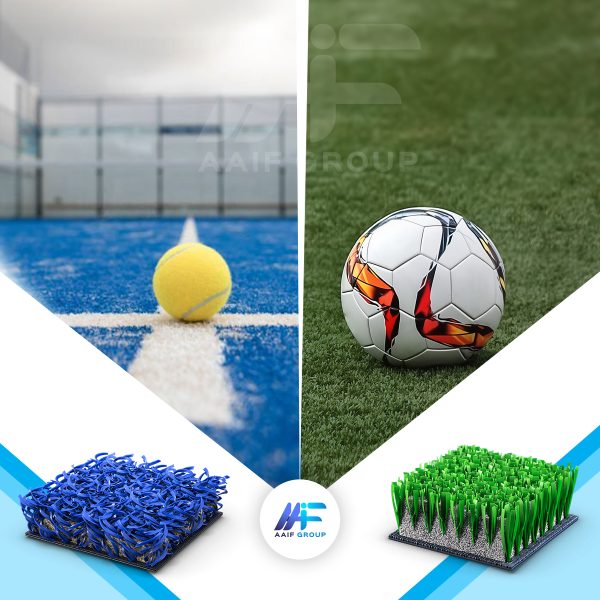
4. Best Padel Turf vs Football Turf – Key Engineering Differences
A serious comparison between padel and football systems goes beyond brand names. It must look at how each surface behaves under real loads.
4.1 Player Movement and Load Patterns
- On padel courts: Movement is compact and explosive, with constant stopping and starting, lateral slides and controlled pivots. The surface must provide grip with enough forgiveness to protect ankles and knees.
- On football fields: Movement includes long accelerations, decelerations, sliding tackles and rotational forces from studs. The field system must spread loads over a large area and maintain stability under more aggressive contact.
For this reason, AAIF Group tunes padel surfaces for agility and comfort on a small footprint, while football systems are tuned for resilience and realistic ball behaviour on much larger pitches.
4.2 Ball Behaviour and Game Feel
- Padel: The court must work together with glass and fence rebounds. Ball bounce should be consistent but slightly moderated by sand-infilled grass, maintaining a fast yet controllable game.
- Football: The pitch must support realistic ball roll, rebound and stopping distance, especially for long passes, crosses and shots, in line with international expectations for synthetic football surfaces.
The combination of fibre profile, infill depth and elastic layers is different for each sport because the definition of “good playability” is different.
4.3 Climate, UV and Drainage in the UAE
Both padel and football surfaces in the UAE must deal with:
- High temperatures and strong sunlight.
- UV exposure that can affect fibres and backing over time.
- Wind-driven sand that can enter the surface structure.
- Occasional heavy rain events.
AAIF Group uses the civil engineering side of its business to design sub-bases, slopes and drainage channels that match each system. The goal is to evacuate water quickly, keep surfaces playable and minimise structural issues such as ponding or premature cracking in the base.
4.4 Lifecycle Cost and Maintenance Reality – Padel Turf vs Football Turf
When developers compare best padel turf vs football turf, the discussion often focuses on upfront installation cost. However, from an engineering and operational perspective, the real differentiator is lifecycle cost — how the surface performs, ages, and consumes maintenance resources over time in UAE conditions.
Padel Turf – High Frequency, Precision Maintenance
Padel courts typically operate at very high booking rates, especially in commercial clubs. Courts may be used continuously from early morning until late night, which places constant stress on fibres, infill distribution, and joint areas.
- Padel turf requires regular brushing to maintain uniform sand distribution and stable grip.
- Glass-to-surface interfaces must remain clean and correctly sealed to avoid infill migration.
- Because the playing area is compact, wear patterns appear faster and must be managed proactively.
In well-designed systems, these maintenance tasks are predictable and controllable. AAIF Group engineers padel surfaces so that grooming, infill top-ups, and inspections can be carried out efficiently without closing courts for long periods.
Football Turf – Load Distribution and Structural Endurance
Football pitches experience different stress profiles. Load is distributed over a larger area, but forces are higher due to sprinting, sliding, and stud penetration. Over time, this affects fibre resilience, shock-pad performance, and base stability.
- Football turf maintenance focuses on fibre uprightness, infill depth control, and surface hardness monitoring.
- Shock pads and foam underlays play a critical role in preserving player comfort and extending surface life.
- Drainage performance directly impacts pitch availability after rain or intensive cleaning cycles.
AAIF Group selects football systems with backing structures and underlay layers that tolerate aggressive play while maintaining performance consistency throughout the pitch.
Why Lifecycle Thinking Matters in the UAE
In the UAE, climate accelerates both wear and operational cost if systems are not engineered correctly. High temperatures, UV exposure, and airborne sand affect padel and football surfaces differently. A lifecycle-driven comparison of best padel turf vs football turf therefore considers:
- Expected resurfacing intervals under realistic usage patterns.
- Maintenance frequency versus facility operating hours.
- Downtime risk and its impact on revenue or community access.
- Compatibility of the surface with future upgrades or sport conversion.
By evaluating surfaces through this long-term lens, AAIF Group helps clients avoid selecting systems that appear cost-effective initially but become expensive liabilities within a few seasons of use.
5. Use-Case Scenarios – Where Each Surface Type Works Best
In real projects, padel and football systems rarely compete directly; they are usually applied to different areas of the same sports complex.
- Padel surfaces: Ideal for rooftop clubs, boutique padel centres, hotel and resort courts, private villas and community sports zones that prioritise social, high-frequency play on compact sites.
- Football surfaces: Essential for academies, schools, municipal sports facilities, private clubs and residential developments that require training or match fields in standard football formats.
AAIF Group often designs sites that combine both: padel courts on one side, football fields on the other, with common walkways, shared service routes and coordinated lighting and branding so the entire venue reads as one integrated sports destination.
5.1 Decision Matrix – How to Choose Between Best Padel Turf and Football Turf
Choosing between best padel turf vs football turf should never be based on brand name or initial price alone. In professional sports projects across the UAE, the correct decision depends on a clear matrix of technical, operational and commercial factors.
Surface Selection Criteria for Padel Courts
- Court size and usage density: Small footprint with very high booking frequency requires turf that maintains grip and fibre resilience under constant play.
- Player movement profile: Lateral slides, short sprints and rapid stops demand controlled friction rather than aggressive traction.
- Infill behaviour: Sand must remain evenly distributed without excessive migration toward glass walls.
- Visual consistency: Fibre colour stability and uniform appearance are critical for premium padel clubs and resorts.
- Maintenance window: Systems must allow quick grooming without extended court closures.
Surface Selection Criteria for Football Fields
- Pitch dimensions and player load: Larger areas with rotational forces from studs require high fibre strength and stable backing systems.
- Shock absorption strategy: Foam underlay or shock pads are essential to manage impact forces over long training sessions.
- Ball roll and rebound: The surface must support predictable ball behaviour across the entire field.
- Drainage capacity: Rapid water evacuation is critical to keep pitches playable after rain or cleaning.
- Lifecycle planning: Systems should allow resurfacing without rebuilding the entire base.
Why a One-to-One Comparison Can Be Misleading
A common mistake in surface selection is trying to compare padel and football systems directly as if they were interchangeable. In reality, each surface is engineered around a completely different definition of performance. The correct comparison is not “which turf is better,” but “which system is better for this specific use-case.”
This is why AAIF Group positions itself as a system integrator rather than a turf supplier. By analysing the full picture—sport type, climate exposure, usage intensity, maintenance capacity and long-term goals—the group helps clients select surfaces that remain functional and profitable long after installation.
Common Selection Errors That Reduce Performance
- Using football-grade turf on padel courts, leading to excessive grip and joint stress.
- Installing padel turf on football areas, resulting in premature wear and fibre collapse.
- Ignoring shock-pad compatibility between turf and sub-base.
- Designing drainage as an afterthought instead of a core system.
- Choosing systems without a defined maintenance strategy.
By avoiding these errors, projects achieve better player experience, longer surface lifespan and stronger return on investment—key reasons why a structured decision matrix is essential when comparing best padel turf vs football turf in the UAE.
6. How AAIF Group Helps You Choose the Right Synthetic Surface
Because AAIF Group controls multiple surface systems and construction disciplines, it does not push a single product. Instead, the team follows a structured selection process:
- Project analysis: Understanding location, available footprint, user groups and commercial targets.
- Sport mix definition: Clarifying how much area is dedicated to padel, to football and to other sports or playgrounds.
- System shortlisting: Matching surface systems from the AAIF Company Profile 2025 to the intended level of play and usage intensity.
- Civil and drainage design: Engineering sub-bases, slopes and channels that support each selected surface.
- Installation and quality control: Supervising works on site, carrying out checks and delivering a ready-to-use facility.
- Maintenance planning: Defining realistic grooming, cleaning and inspection routines that protect performance and appearance.
This approach keeps the focus on how the surface will perform over years of real use, not just how it looks in a brochure.
7. Internal Links – Explore Related AAIF Group Services
- Padel court design and construction in the UAE
- Football field construction and synthetic grass systems
- Indoor and outdoor sports flooring systems
- Reference sports facilities delivered by AAIF Group
8. External Standards and References
9. FAQs – Best Padel Turf vs Football Turf
Can the same synthetic grass be used for both padel and football?
In practice, no. The movement patterns, ball behaviour and loading are very different, so AAIF Group recommends sport-specific systems that are engineered separately for padel courts and football pitches.
Which football system from AAIF is “best”?
There is no single best option for every project. AAIF compares UK, Vietnam, Poland and China systems from its portfolio against your pitch size, usage hours, budget and maintenance capability, then recommends the most suitable combination.
What defines the best padel surface for UAE projects?
The best padel solution is one that combines UV resistance, stable grip, good drainage and comfortable impact behaviour, all built on a correctly engineered base with glass, steel and lighting designed to work together.
Can AAIF build a mixed sports complex with both padel and football?
Yes. AAIF Group regularly designs and builds multi-sport facilities that include padel courts, football fields and other surfaces, with one coordinated master plan and a single accountable project team.
How can we start a surface selection process with AAIF Group?
The first step is a consultation or site visit request. AAIF’s team studies the site, clarifies your goals and then proposes matched surface packages for padel, football and any other sports areas required.
10. Start Your Next Surface Project with AAIF Group
Whether you are planning a boutique padel club, a community football field or a complete sports complex that combines both, AAIF Group provides engineering-led, climate-ready and turnkey solutions across the UAE and GCC. By matching surface systems from the AAIF Company Profile 2025 to real-world project requirements, the group helps you build facilities that stay safe, attractive and commercially successful over the long term.
📞 +971 50 306 6753
🌐 www.aaifgroup.com